

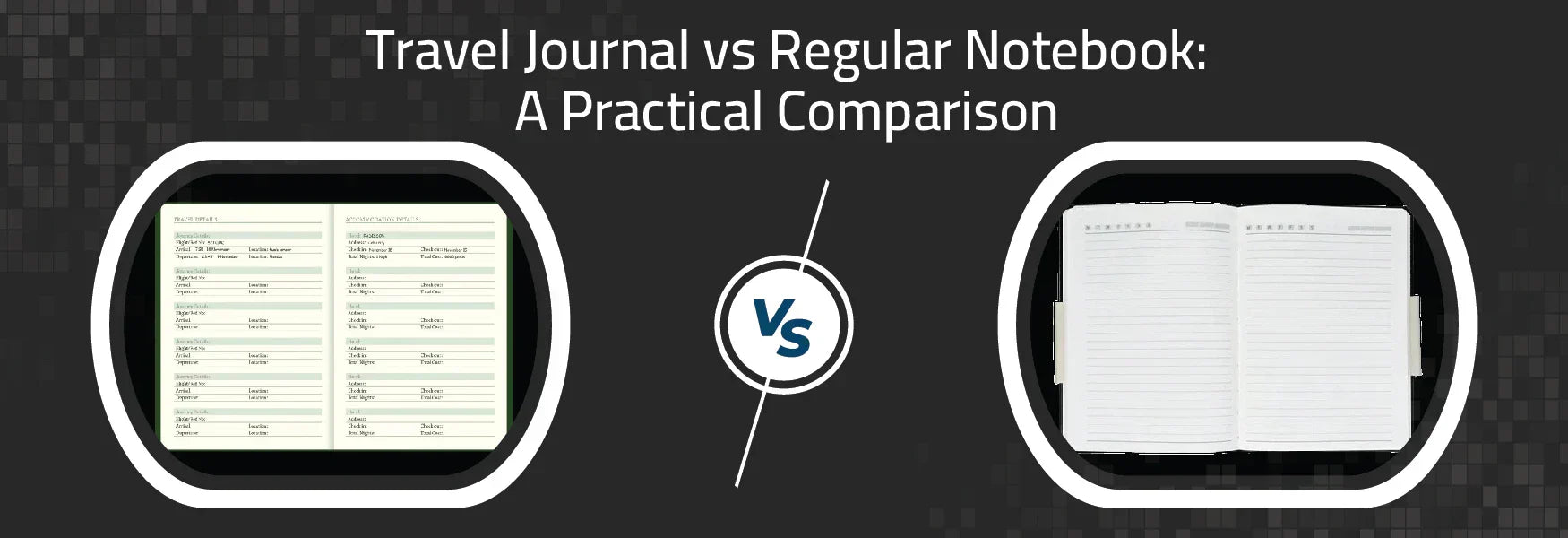
Both a travel journal and a regular notebook may seem interchangeable at first. After all, they both offer pages, covers, and space to write. But when you are travelling, does that choice really make a difference? Think about how you want to capture your journey: quick notes and plans or detailed memories and reflections. The answer lies in how each one is designed to be used. While a notebook focuses on structure and utility, a travel journal is created for storytelling and personal expression. In this blog, we will explore the key differences to help you choose what truly fits your travel style.
Find the right journal for your travel style
Explore JournalsA] What Each One Is Actually Built For
1. The Purpose Behind a Regular Notebook
A regular notebook is a practical, everyday tool. It is used for note-taking, to-do lists, planning, or work-related tasks. The layout is typically structured to organise information clearly and efficiently. While it works well for capturing quick thoughts, it is not designed for deeper reflection or storytelling. It serves function over emotion.
2. The Purpose Behind a Travel Journal
A travel journal is created with a very different intention. It is meant to capture experiences, emotions, and personal reflections from your journey. Instead of structured notes, it encourages free-flowing writing and creative expression. It is not just a blank book but a dedicated space where memories, stories, and moments can be preserved in a meaningful way.
B] The Physical Differences You'll Notice Straight Away
1. Cover and Build Quality
- Durable Covers: Travel journals are designed to handle movement, weather, and frequent use.
- Premium Materials: Often made with stronger finishes like PU for added protection.
- Everyday Build: Regular notebooks usually use lighter materials suited for desk use.
- Enhanced Durability: Many travel journals use premium materials to better withstand frequent handling and travel conditions.
2. Size, Portability and Lay-Flat Binding
- Compact Sizes: Travel journals are easy to carry in small bags or even pockets.
- Lay-Flat Design: Makes writing across pages comfortable and practical.
- Varied Notebook Sizes: Regular notebooks are not always designed for portability.
-
Travel-Friendly Formats: Many travel journals are designed for on-the-go use, allowing quick access whether you are commuting, sightseeing, or in transit.
C] Paper Quality and What It Means for Travellers
1. Why Paper Weight Matters on the Road
- Supports Multiple Tools: Travel journal paper handles pens, markers, and light art materials.
- No Bleeding or Tearing: Higher GSM paper prevents ink spread and page damage.
- Mixed-Media Friendly: Suitable for tickets, stamps, and pasted keepsakes.
- Notebook Limitation: Thin paper in regular notebooks may not support such use.
- Sustainable Choices: If you are considering environmentally responsible options, you can explore our guide on eco-friendly notebooks to better understand material choices.
2. Ruling and Page Layout
- Flexible Layouts: Blank, dotted, or lightly ruled pages allow creative freedom.
- Encourages Expression: Ideal for writing, sketching, and memory-keeping.
- Structured Lines: Regular notebooks usually have narrow ruled pages.
- Less Flexibility: Fixed formats of notebooks can feel restrictive for journaling.
D] The Features That Make a Travel Journal Stand Out
1. Built-In Details Designed for Journalers
- Ribbon Bookmarks: Help you quickly return to your latest entry without flipping through multiple pages.
- Elastic Closures: Keep the journal securely shut, preventing loose pages or inserts from falling out during travel.
- Back Pockets: Provide a convenient space to store tickets, receipts, postcards, and other flat keepsakes collected along the way.
-
Purpose-Driven Design: These thoughtful additions enhance usability, making travel journals more functional than standard notebooks.
2. Prompts and Guided Sections
- Writing Prompts: Offer helpful cues that make it easier to reflect on experiences, especially after a long day of travel.
- Itinerary Pages: Allow you to plan and document your travel itinerary in one place, keeping everything organised and easy to revisit.
- Beginner Friendly: Guided sections reduce the pressure of starting from a blank page, making journaling more approachable.
-
Open Flexibility: At the same time, most travel journals still leave room for free expression beyond structured prompts.
E] When a Regular Notebook Works Just Fine
1. Not Every Trip Needs a Dedicated Journal
For short trips or simple travel plans, a regular notebook can be enough. If your goal is to jot down quick notes, itineraries, or reminders, you may not need a full journal. A ruled notebook or pocket notebook can be a practical option. They are compact, easy to carry, and offer a good balance between basic note-taking and light journaling needs.
2. Match Your Journaling Style to the Right Product
- For Memories: Choose a travel journal for storytelling and reflection.
- For Practical Notes: A regular notebook works for logistics and quick entries.
- For Versatility: A wide range of journals and notebooks are available to suit different writing styles, preferences, and travel needs.
-
Explore Options: Browse different journal and notebook styles to find what best suits your travel needs.
Need assistance choosing the right journal or notebook?
Contact UsConclusion
The difference between a travel journal and a regular notebook comes down to purpose, design, paper quality, and features. While notebooks are great for structured notes, travel journals are built to capture experiences in a more personal and lasting way. The right choice depends on how you want to document your journey. Options from brands such as Scholar Stationery cater to both styles, offering something for every kind of traveller. If you are unsure which one suits you best, feel free to contact us and we will help you choose the right companion for your travels.
FAQs
1. What is the difference between a travel journal and a notebook?
A travel journal is designed to capture experiences, memories, and reflections, while a notebook is mainly for structured notes, lists, and everyday writing tasks.
2. Can I use a notebook as a journal?
Yes, you can use a notebook as a journal, but it may lack the layout, paper quality, and features that make journaling more expressive and convenient.
3. Can you use a regular notebook for bullet journaling?
Yes, a regular notebook can be used for bullet journaling, though dot-grid or blank pages are usually preferred for better flexibility and layout design.
4. Do travel journals come with prompts and layouts?
Many travel journals include prompts, guided sections, or flexible layouts to help users document their experiences more easily.
5. Which is better for long trips: a travel journal or a notebook?
A travel journal is better for long trips, as it is designed for durability, reflection, and memory-keeping over extended periods.